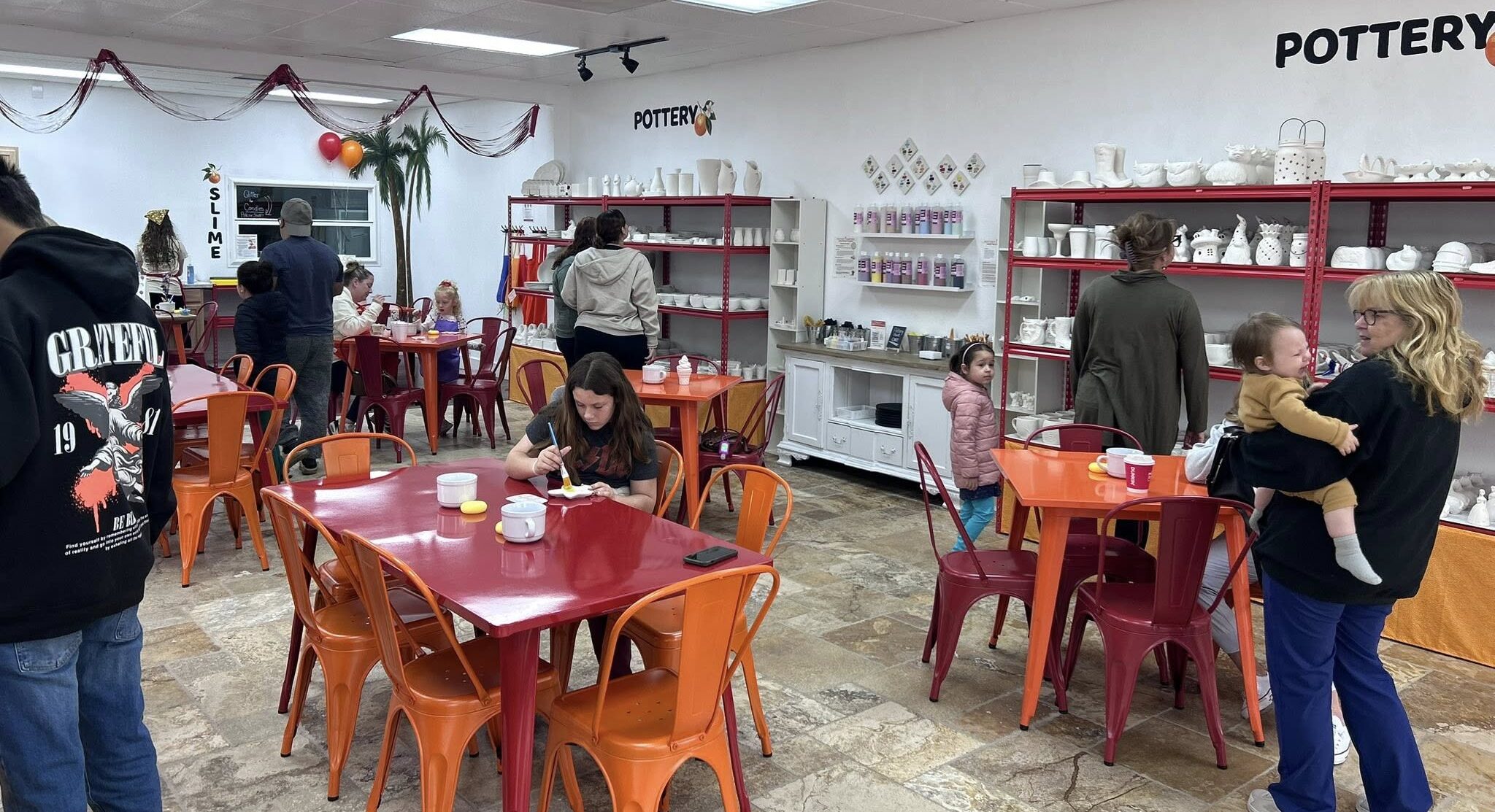
Opening A Creative Franchise in Tampa’s Fast-Growing Suburb
February 6, 2026 by
The Hot Spot Studios Franchising
For Jacob and Michaela Wilson, owners of The Hot Spot Studio in Lutz-Wesley Chapel FL, the decision to open a creative franchise began with a key life event that challenged them to reassess everything they thought they wanted, from their careers, family, and the future.
Michaela spent the last nine years working in accounting. Jacob, a military veteran who completed multiple overseas tours, transitioned into civilian life working as an assistant superintendent at a nearby golf course. When their youngest child was born, their sense of financial stability started to feel different.
“At that point, we really started asking ourselves what we wanted our life to look like,” Jacob says. “Not just right now, but long term, for us and for our kids.” Michaela came across an advertisement for The Hot Spot Studios while scrolling through Facebook. It didn’t feel like a dramatic discovery or an immediate call to action. But unlike most ads, it lingered. “I was just scrolling like anyone else,” Michaela says. “But this one stopped me. It felt familiar.”
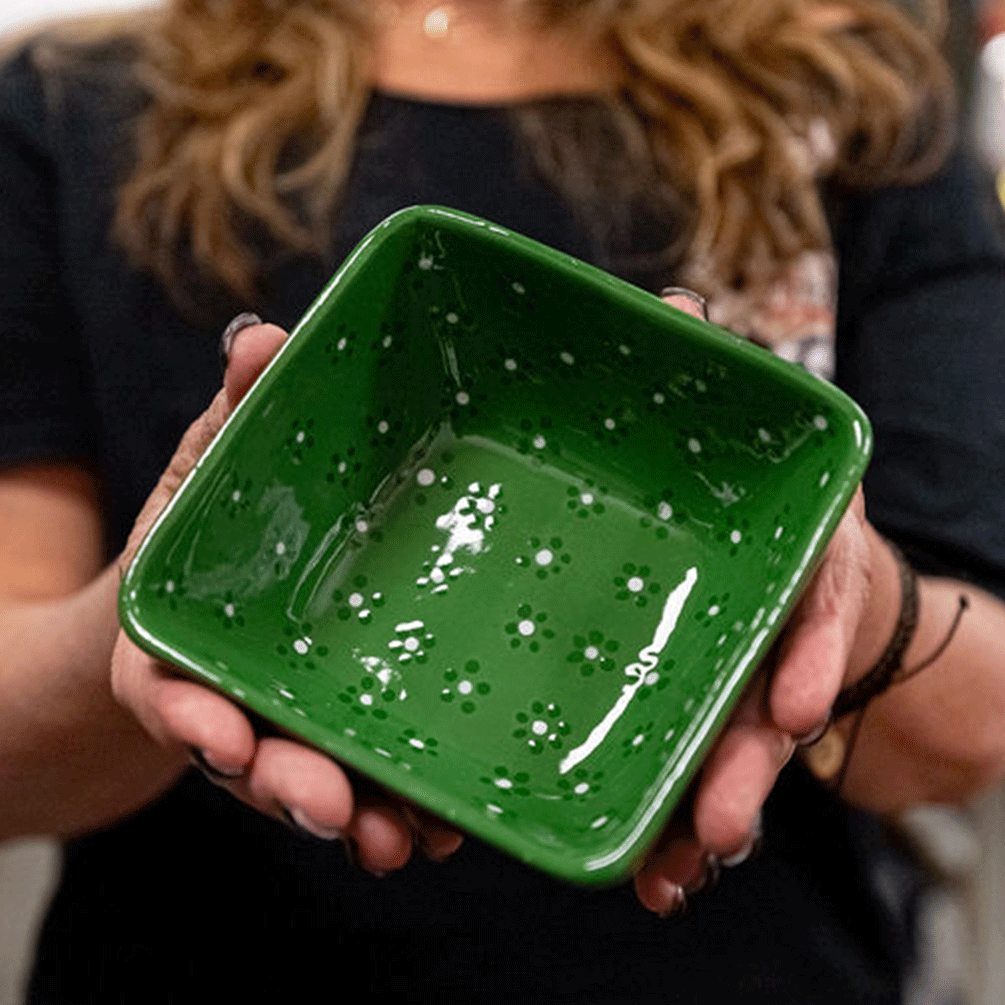
The familiarity came from creativity. Michaela had always gravitated toward art, both personally and as a parent. Between school projects, and hands-on activities with her older children, the idea of running a paint your own pottery studio felt like a good fit. “I’ve always had an art background,” she explains. “Creativity has always been part of my life, especially with the kids.”
What caught her attention wasn’t just the concept, but how realistic it felt. She could easily imagine herself running the studio day to day. When she shared the idea with Jacob, the conversation shifted quickly from curiosity to consideration. “We didn’t just say, ‘That’s cool,’ and move on,” Jacob says. “We actually sat down and talked it through.”
They talked about finances. They talked about risk. They talked about what it would mean for Michaela to step away from her career and for their family to rely on one primary income while building something new. “We asked the real questions,” Jacob adds. “Could the bills still be paid? What would change if we did this?”
What stood out most was that the opportunity aligned naturally with where they already were in life, raising young children, valuing flexibility, and wanting work that felt connected to family and community. “It didn’t feel like we had to become different people to make it work,” Michaela says. “It felt like building on what we already cared about.”
In a landscape crowded with options, side hustles, and noise, this opportunity felt unusually clear. It wasn’t about escaping something that wasn’t working. It was about recognizing that the right next step had presented itself at exactly the right moment, and they were willing to take it seriously.
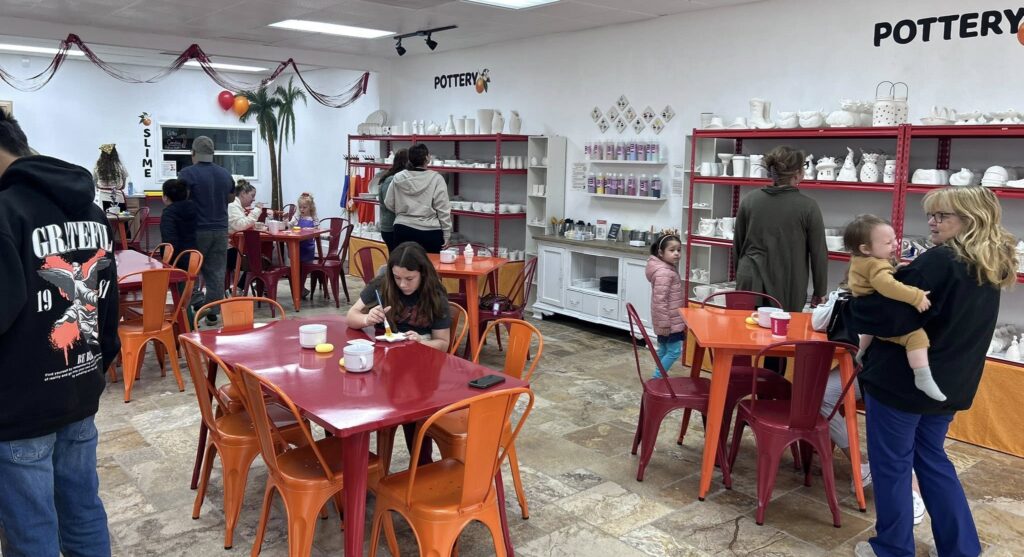
Related Article: The Creative Franchise That’s Capturing Nationwide Attention
The Hot Spot Model Stood Out
Once the idea of franchise ownership was on the table, Jacob and Michaela didn’t rush. If they were going to take on the responsibility of owning and operating a business, the model itself had to make sense both personally, and for the kind of community they wanted to serve.
They began looking at other creative businesses for comparison, especially ones centered around painted pottery experiences. What quickly became apparent was how narrow many other existing concepts felt limited. A single activity might draw someone in, but it didn’t always encourage repeat visits or appeal across different age groups the way Hot Spot Studios addresses all ages groups and experience levels.
“The big thing that stood out to us was that it wasn’t just pottery,” Jacob explains. “Everywhere else we looked felt very one-dimensional.” The Hot Spot Studios’ model is different by design. Instead of centering on one activity, they offer multiple creative experiences under one roof from pottery and canvas painting, to other hands-on projects like candle making, succulent mini gardens, and even slime making, that could change from visit to visit. That flexibility mattered.
“You can come in one day and do one thing, and come back another day and do something completely different,” Michaela says. “That was really important to me.” For Michaela, the model aligned naturally with her background and interests. Creativity was already part of her daily life, especially as a parent helping her children explore and create, and the studio felt like an extension. For Jacob, the appeal was structural. A business built around variety and repeat engagement felt more sustainable than one dependent on a single offering. “It just felt like it gave people a reason to keep coming back,” he says. “This felt like something that could stay relevant,” Jacob adds. “Not just now, but long-term.”
Related Article: Art Franchises Build Community Loyalty
Taking The Leap
By the time Jacob and Michaela reached a decision, the excitement around the concept had already been tempered by reality. This wasn’t a leap taken lightly. It was a calculated choice made during a season of life where the stakes felt especially high. “There’s always that what-if factor,” Jacob says. “That skepticism of, is this really the right move?”
They approached the decision methodically. They laid out their finances. They talked through what it would mean for Michaela to step away from a long-held career. They examined how their household would function on one primary income while they built something new from the ground up. “It’s not just money,” Jacob explains. “It’s time, effort, and not knowing what the outcome is going to be.”
The franchise process itself played an important role in helping them evaluate that risk. Multiple interviews, conversations with the corporate team, and exposure to existing franchise owners gave them room to ask direct questions and hear unfiltered experiences.
“We went through several interviews,” Jacob says. “They really wanted to make sure it was the right fit for us and for them.” What pushed them forward was alignment. The model made sense. The support structure felt real. And the risk, while undeniable, felt intentional rather than reckless. “If you don’t take a chance, you don’t know what the outcome is going to be,” Jacob says. “And we didn’t want to look back and wonder what could’ve happened if we hadn’t tried.”
Choosing The Right Market
With the decision to move forward now made, the next question was where to open. For Jacob and Michaela, choosing the right market was as critical as choosing the right franchise. “We really wanted to be in the right spot,” Jacob says. “Not just somewhere convenient, but somewhere that actually made sense for this kind of business.”
Their focus narrowed to the Lutz–Wesley Chapel area, a fast-growing corridor just north of Tampa Florida that has seen steady residential development over the past several years. New neighborhoods, schools, and family-centered communities continue to expand outward, drawing in households looking for space, stability, and a strong sense of place.
What stood out most was who was moving there. Families with young children, active lifestyles, discretionary income with the ability to spend on experiences rather than just necessities make up a large part of the area’s population. At the same time, many families in nearby Tampa travel for entertainment and creative activities.
“There really wasn’t anything like this around where we live,” Michaela explains. “There are pottery places, but nothing where you can do multiple things.” They wanted to be part of a community that was still forming its routines; a place where a new creative space could become familiar faster than competing for attention.
They also paid close attention to everyday traffic patterns. Being near schools, churches, shopping centers, and other family-oriented destinations wasn’t accidental. The goal wasn’t just visibility, but relevance, placing the studio where it naturally fit into people’s daily lives.
“We wanted to be where families already are,” Jacob says. “Somewhere people are already driving by and stopping.” Lutz–Wesley Chapel occupies a unique position in the Tampa region, blending suburban growth with a strong local identity. It sits between long-established neighborhoods and newer developments pushing outward, creating a balance of familiarity and momentum.
Related Article:Pottery Franchise: 10 Reasons to Own a Paint-Your-Own Pottery Franchise
Introducing Something New
When the studio first opened, Jacob and Michaela quickly realized that their role wasn’t just about managing a space or overseeing projects. Their real work, at least in the beginning, was introducing an entirely new idea to the community.
From the very first days, curiosity led the way. People slowed down as they walked past the storefront. Others stopped Michaela as she was unlocking the door, asking what kind of place it was and what happened inside. “They’d ask, ‘Are you the owner?'”, Michaela says. “and I’d say yes and invite them in to look around.”
Those early interactions were great introductions. Michaela spent time walking people through the space, explaining how the studio worked, and helping them imagine what they could do there without pressure or expectation.
“I just tell them to come in and check it out,” she says. “Once they see it, it makes sense.” Michaela focused on approachability. The studio was framed as a place to explore, experiment, and create at whatever pace felt comfortable.
Each interaction helped them refine how they talked about the studio and what aspects resonated most, whether it was the variety of projects, the absence of studio fees, or simply the freedom to try something new.
In a growing area like Lutz–Wesley Chapel, where many residents are still discovering what businesses exist around them, that introduction period mattered. It was the foundation for becoming part of the community’s everyday awareness. “One of the coolest things was when someone finished a project, left, and then came back and decided to do more,” Jacob says. “That really stood out to us.”
Customers didn’t just come in, complete a project, and move on. Some stayed longer than expected. Others returned after picking up finished pieces and chose to start something new. In a few cases, people who initially stopped in out of curiosity made the decision to spend more time there before they even left. “That tells you a lot,” Jacob explains. “It shows they’re comfortable, and that they’re enjoying being there.”
Another positive early indicator came through conversation. Guests began asking about birthday parties, group events, and future activities. “We’ve already had people asking about parties and events,” Michaela says. “That was exciting to hear so early on.” In a community like Lutz–Wesley Chapel, where new businesses often need time to become familiar, those early behaviors suggested something important: the studio was beginning to feel like it belonged.
Discovering Opportunities
“A lady came in one night and asked about doing something for a wedding,” Jacob says. “That wasn’t even on our radar. It opened our eyes,” Jacob explains. “People were already imagining how to use the space in ways we hadn’t thought about yet.” These moments mattered because they came from people seeing the space, understanding the concept, and then projecting their own needs onto it.
For a new business in a growing area like Lutz–Wesley Chapel, that kind of engagement was meaningful. It suggested the studio wasn’t just filling a gap. It was becoming a platform for creativity, celebration, and connection in ways that couldn’t be fully planned in advance. Rather than trying to force the studio into a fixed definition, Jacob and Michaela began to let those conversations guide their thinking.
Awareness Through Personal Connection
Rather than waiting for people to discover the studio on their own, Jacob and Michaela made a deliberate choice to be visible. “We felt like in-person advertising was way more effective,” Jacob says. “Actually talking to people made a difference.”
They spent time going into the community, visiting gyms, preschools, daycares, churches, and nearby businesses. Sometimes it meant handing out flyers. Other times it meant simply introducing themselves and explaining what the studio was about. “When you talk to someone face to face, you can tell right away if it clicks,” Michaela says. “Once they understand what it is, they get excited.”
As their grand opening approached, Jacob and Michaela were intentional about how they framed it as a formal invitation to the community they had already begun to engage. “We didn’t see it as this huge finish line,” Jacob says. “It was more like saying, ‘Hey, we’re here …come check us out!’”
Related Article:Are Paint-Your-Own Pottery Franchises Profitable?
The Plan For The Future
From the beginning, Jacob & Michaela’s goal was never just to run a business. It was to build something that felt personal, welcoming, and genuinely rooted in the community they chose. “I want people to feel like they’re part of the family when they come in,” Michaela says. “Not like they’re just another customer.”
That mindset shapes how the studio operates day to day. Michaela’s presence in the space and Jacob’s hands-on involvement outside of his full-time job reinforce that this isn’t a passive investment. It’s something they are actively building, refining, and growing alongside the community.
“Our goal is eventually to open another location,” he says. “And to leave something for our kids if they ever want to be part of it.” In an area like Lutz–Wesley Chapel, still defining its identity as it grows, that intention matters.
New businesses may open quickly, but places that people feel connected to take time. Jacob and Michaela want the studio to become part of those routines: birthday traditions, group outings, creative breaks, and everyday moments that matter.
In one of Tampa’s fastest-growing suburbs, Jacob and Michaela Wilson aren’t just opening a creative franchise; they’re beginning a relationship with a developing area still taking shape, and inviting the community to help define what comes next.
If you or someone you know would like to learn more about owning a Hot Spot Studios franchise, contact The Hot Spot Studios franchising team to get started on your own journey toward ownership.
Be The Hot Spot In Your Town!
Take the next step to learn more about becoming a Paint Your Own Pottery Franchise owner with The Hot Spot Studios! We will promptly return your inquiry, answer all your questions, provide you with our downloadable franchise brochure, packed with important franchising information.

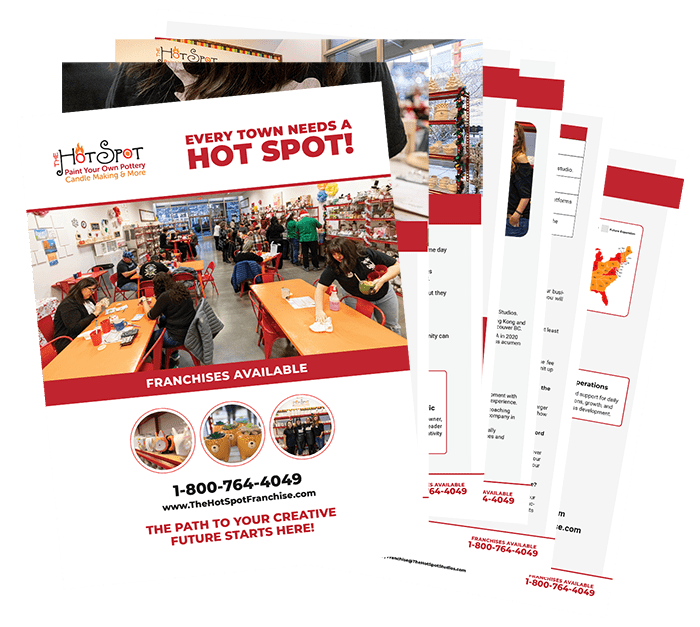
Get Started & Download Our Franchise Guide
Continue Exploring
See our story, values, and leadership team in the About Us page. Learn more about the paint your own pottery franchise opportunity, investment costs, and Path To Ownership. Or contact us now to Get Started, and speak with a franchising representative that will answer all of your questions.
About Us
Get to know the team and story behind The Hot Spot Studios 28+ years of successful growth.
- Our Mission
- Our Values
- Leadership Team

Path To Ownership
Explore the journey towards painted pottery franchise ownership, and available territories.
- Investment & Costs
- FAQ & Training
- Available Territories

Get Started
Take the first step in your creative art business venture, and connect with us today!
- Contact Us
- Receive More Information
- Take The Next Step